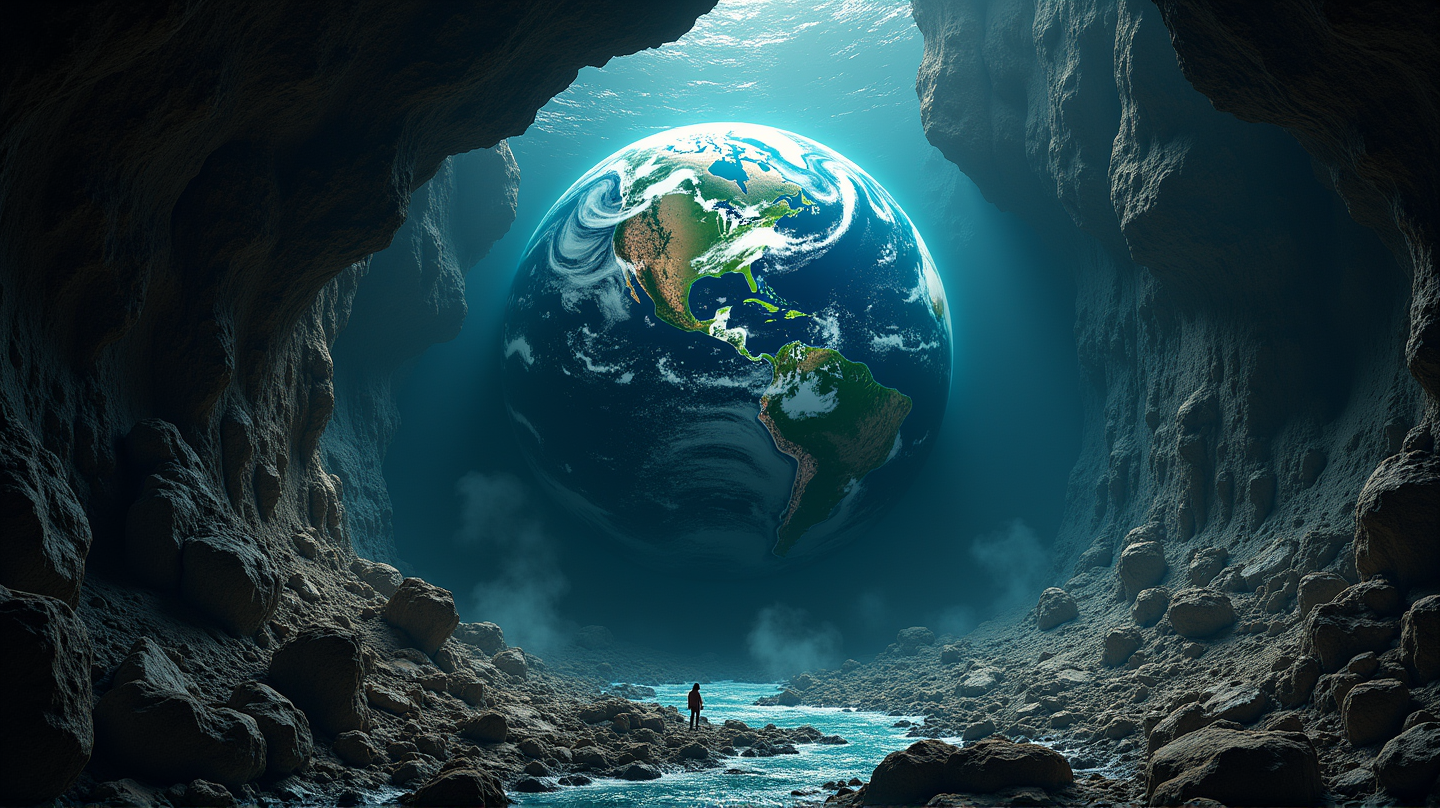
Introduction: A Watery Past
In the chaotic infancy of our planet, Earth was subjected to relentless asteroid impacts and comets that brought much of the water we see today. But there’s a twist in the tale: recent studies suggest that young Earth could trap significantly more water than scientists had previously believed, possibly equating to a whole ocean’s worth hidden in its ancient rocks. This intriguing revelation challenges the conventional understanding of Earth’s early water cycle and opens new doors of exploration.
Bridgmanite: The Water Keeper
The key player in this narrative is bridgmanite, a deep mantle mineral renowned for its ability to incorporate water into its structure under high temperatures and pressures. Researchers like geochemist Wenhua Lu have demonstrated through cutting-edge experiments that this mineral might have trapped up to 100 times more water than earlier estimates suggested. These findings not only provide insights into Earth’s formation but also illuminate the evolutionary trajectory of its habitability.
Recreating Earth’s Early Conditions
In their quest for answers, scientists have replicated the extreme conditions of Earth’s interior using precise laboratory apparatuses, such as laser-heated diamond anvils. By applying immense pressures and temperatures, they observed bridgmanite’s ability to increase its water content, an observation that provides a glimpse into the immense water reservoirs that may still be nestled deep within our planet today.
Unraveling the Mysteries of the Mantle
Bridgmanite forms abundantly in Earth’s mantle, making up about 60% of it, and can endure temperatures exceeding 4000°C and pressures reaching 700,000 atmospheres. During Earth’s Hadean Eon, this mineral would have sequestered water molecules dissolved in the magma ocean as it cooled, forming a reservoir that plays a crucial role in our current water dynamics. This process is still active today, facilitated by subducted tectonic plates and volcanic activity. According to Science News, understanding these intricate cycles is key to comprehending Earth’s geologic past and present.
A Puzzle Piece in Earth’s Narrative
Petrologist Michael Walter remarks that these findings add a vital layer to our knowledge of the geological puzzles. They suggest how primitive reservoirs deep within the Earth mingle with surface waters through the vibrant artistry of tectonic movements. Such revelations push the boundaries of geoscience, urging us to rethink how the Earth’s water cycle has operated over eons.
Conclusion: Unveiling Earth’s Hidden Reservoirs
As researchers further delve into the mysteries of bridgmanite and the deep mantle, they unearth stories of Earth’s formative years that rival science fiction. These discoveries allow us to reimagine a young Earth, its core a swirling mass of possibilities, and its surface a canvas waiting for life. The journey into the heart of our planet continues, promising a treasure trove of insights into the hidden waterways of our very own blue marble.
Examine these new frontiers in geology and stay informed about how fundamental questions on Earth’s formation are being answered through innovative research and exploration.